

You do not necessarily need to wait until you reach your goal weight to discuss facial changes during medical weight loss in Herndon. The right time depends on what is changing, how much additional weight loss is expected, your facial anatomy, and whether the concern involves volume, laxity, skin quality, or dynamic wrinkles.
Current research does not show that GLP-1 medications preferentially cause facial-fat atrophy — PMC.
Visible hollowing, folds, or laxity can still feel significant even when weight loss is improving your health. At RxWellness Herndon, we can consider aesthetic assessment alongside your medically supervised weight-loss progress so treatment decisions reflect both where you are now and where your weight trajectory may be heading.
Related: Can I Improve Jowls in Herndon Without Surgery?
What Causes Facial Changes During Medical Weight Loss in Herndon?
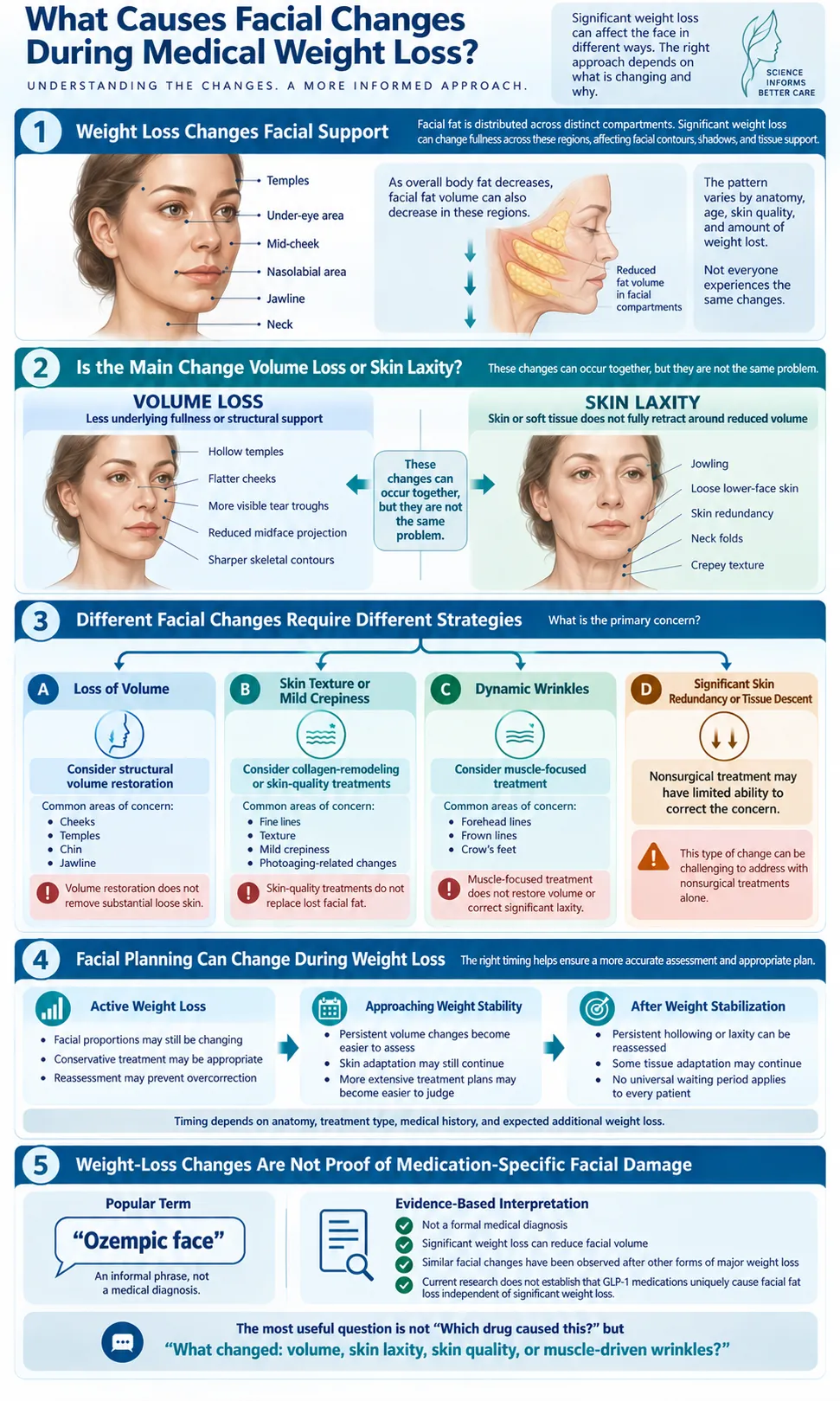
Facial changes during substantial weight loss usually reflect changes in underlying soft-tissue volume combined with your existing anatomy and skin elasticity. Cheeks, temples, the eye area, the jawline, and the neck may respond differently, which is why the resulting appearance varies considerably from person to person.
Facial Volume Can Decrease
As body weight decreases, facial fat may also decrease, reducing fullness or projection in areas that previously helped support facial contours. The amount and location of visible change vary widely.
- Cheeks may appear flatter as underlying volume decreases.
- Temples can develop a more hollow appearance.
- Periorbital contours may become increasingly noticeable.
- Larger weight changes may produce more visible facial differences.
Research examining substantial weight loss found particularly notable volume reduction in the mid-cheek along with increased central neck laxity — Aesthetic Surgery Journal Open Forum.
This combination matters because a face can simultaneously lose fullness in one region while developing looser tissue elsewhere. Treating those two concerns as identical can lead to poorly matched aesthetic choices.
Skin May Not Retract Equally
Losing underlying volume does not guarantee that the overlying skin will tighten to the same degree. Skin recoil depends on tissue characteristics that differ substantially among patients, especially after significant weight reduction.
- Lower-face laxity may become more noticeable after volume loss.
- Neck skin can appear looser as underlying fullness decreases.
- Age influences how readily skin adapts to changing contours.
- Photodamage and smoking can affect skin elasticity.
- Menopausal changes may also influence tissue quality.
Some adaptation may continue as weight change slows, but no reliable method predicts exactly how much tightening an individual patient will experience. That uncertainty is one reason clinicians may reassess persistent laxity rather than promising it will resolve on its own.
Weight Loss Is Not the Same as Medication Damage
“Ozempic face” is a colloquial description, not a medical diagnosis. Although the phrase is widely used, research directly measuring medication-specific facial changes remains limited and does not establish that GLP-1 treatment uniquely damages facial fat.
- Similar facial changes occur after substantial bariatric weight loss.
- Significant weight reduction can change facial volume regardless of method.
- Medication use alone does not identify the cause of every change.
- Health benefits of appropriate weight loss remain important.
A more useful clinical question is not whether a medication has “aged” the face, but which anatomical changes are present and whether they are likely to keep evolving during continued weight reduction.
How Do Volume Loss and Skin Laxity Affect Facial Treatment Planning?
Treatment planning begins by determining what is actually producing the visible change. Restoring lost volume, addressing loose skin, improving texture, and relaxing muscle-driven wrinkles are distinct goals, and no single aesthetic procedure can reasonably accomplish all of them.
Volume Loss Changes Facial Support
Facial fat is distributed regionally rather than as a single continuous layer, so weight loss can change some contours more noticeably than others. Reduced support may also make preexisting hollows, folds, and bony features more apparent.
Research demonstrates that facial subcutaneous fat is organized into multiple independent anatomical compartments — Plastic and Reconstructive Surgery.
- Reduced midface projection can deepen existing facial shadows.
- Tear-trough contours may become more visually prominent.
- Changes in cheek volume can alter surrounding facial proportions.
- Bony landmarks may appear sharper as soft tissue decreases.
This compartment-based anatomy helps explain why facial volume loss after weight loss rarely looks identical between two patients. Assessment needs to identify where support changed before deciding whether restoring selected volume makes sense.
Laxity Is a Different Problem
Loose or descended skin requires a different approach than regional volume loss. Adding filler to an area with substantial tissue redundancy does not remove the excess skin and may create unwanted heaviness if overused.
- Jowling can reflect tissue descent rather than simple hollowing.
- Neck redundancy is more consistent with laxity than with loss of projection.
- Filler cannot remove substantial loose or hanging skin.
- Excessive volumization can distort natural facial proportions.
Some patients have both volume loss and laxity, which makes restraint particularly important. A clinician may prioritize specific structural deficits while acknowledging that minimally invasive treatment has limits when skin redundancy is the dominant concern.
Skin Quality and Wrinkles Add Another Layer
Texture, fine lines, photodamage, and dynamic wrinkles can become more noticeable during facial change, but they arise from different processes than facial fat loss. Therefore, choose treatments independently.
- Microneedling supports collagen remodeling and texture goals.
- Chemical peels address selected surface-level skin concerns.
- Neurotoxins target wrinkles produced by repeated muscle movement.
- None of these treatments replaces lost facial fat.
Separating these concerns prevents a single visual label from driving the treatment plan. Someone bothered by fine lines may need a different approach from a patient whose primary concern is reduced cheek projection or neck laxity.
Which Treatments Can Address Facial Changes During Weight Loss?
Treatment depends on which facial feature bothers you and whether that feature is likely to keep changing. Some conservative treatments may be appropriate during active weight loss, while larger volume corrections may benefit from reassessment as your weight stabilizes.
Restoring Selected Facial Volume
Dermal filler may be considered when a clearly defined area has lost projection or support. During ongoing weight loss, conservative treatment can help avoid trying to recreate a final facial shape that has not yet developed.
- Cheek filler may restore selected midface projection.
- Temple treatment can address localized hollowing when appropriate.
- Chin or jawline filler may improve structural balance.
- Fold treatment should consider broader facial support first.
Filler does not recreate a person’s prior facial fat distribution and should not be marketed as a universal solution for post-weight-loss facial changes. If substantial additional weight loss is expected, staged treatment may be more appropriate than extensive correction at once.
Improving Skin Quality
Skin-focused treatments may be useful when texture, fine lines, or mild crepiness remain concerns despite changes in facial volume. These treatments work through skin remodeling rather than by replacing depleted fat compartments.
- Microneedling creates controlled stimulation for collagen remodeling.
- PRP may be used as an adjunctive rejuvenation approach.
- PRF can support selected regenerative skin-quality goals.
- Chemical peels can address appropriate surface-level concerns.
Evidence specifically studying these treatments after GLP-1-associated weight loss is limited. Their role should remain focused on the skin concerns they are designed to address rather than claims that they can restore facial fat.
Treating Dynamic Wrinkles Separately
Neurotoxin injections address lines caused by repeated muscle contractions, making their role narrower than that of treatments intended to restore volume. These wrinkles may remain relatively stable even as facial proportions change.
- Forehead lines can reflect repeated muscle activity.
- Frown lines are not primarily a volume-loss problem.
- Crow’s-feet can be treated independently of facial fullness.
- Neurotoxins do not restore lost facial support.
Because dynamic wrinkles do not depend on your eventual facial fat distribution, treatment may sometimes make sense during active weight loss. Candidacy still depends on your medical history, anatomy, goals, and clinical assessment.
If you’re concerned about facial changes during medical weight loss in Herndon, our team at RxWellness Aesthetics & Anti-Aging is here to help. Call (571) 569-6546 to schedule your consultation.
What Should You Expect If You Seek Aesthetic Care While Still Losing Weight?
Aesthetic care during active weight loss should be conservative and focused on reassessment. Your clinician needs to understand your current concern and consider whether continued weight loss may change facial volume, skin drape, or overall proportions before planning larger correction.
Start With the Weight-Loss Trajectory
How much additional weight you expect to lose can influence aesthetic timing, as the face may continue to change throughout active weight reduction. Cosmetic concerns should not override medically appropriate weight-loss goals.
- Significant future loss may continue altering facial proportions.
- Smaller remaining changes may make assessment more predictable.
- Treatment plans can be adjusted as your weight changes.
- Medical goals should remain based on health needs.
RxWellness offers medically supervised weight-loss care with monitoring, personalized dosing, nutrition and exercise guidance, and body-composition tracking. That context helps clinicians consider anticipated weight change when discussing aesthetic timing.
Expect a Facial Assessment
A consultation should identify the specific anatomical issue rather than treating every visible change as one condition. Volume, laxity, texture, pigment, and dynamic lines each require their own assessment.
- Evaluate facial volume by region and proportion.
- Assess skin laxity separately from hollowing.
- Texture and pigment concerns require skin-specific evaluation.
- Prior fillers or procedures may influence future treatment.
- Medical history helps determine procedural candidacy.
The resulting plan may be staged, with some concerns addressed now and others reassessed later.
Conservative Treatment May Make Sense
You don’t need a final number on the scale for every aesthetic concern. Treatment may be reasonable when the problem is stable enough and further weight loss is unlikely to undermine the immediate goal.
- Dynamic wrinkles may remain treatable during active loss.
- Skin-quality concerns can sometimes be addressed independently.
- Small volume corrections may be approached conservatively.
- Larger corrections may benefit from later reassessment.
This allows treatment without aggressively correcting facial proportions that may still change.
Who Should Consider Treatment Before or After Weight Stabilizes?
Candidacy depends more on the treatment being considered than on a universal goal-weight requirement. Patients actively losing weight may still qualify for selected conservative procedures, while broader volume restoration or persistent laxity may become easier to plan once weight change slows.
Candidates During Active Weight Loss
Treatment during active weight reduction may be reasonable when the concern is relatively stable, and the patient understands that future weight loss could still affect facial proportions or results.
- Expectations should account for continued facial change.
- Treatment should address a clearly identified concern.
- Conservative correction may reduce later over-treatment.
- Follow-up assessment remains part of the plan.
Consider procedures that do not depend heavily on final facial volume earlier, once medical screening confirms candidacy.
Candidates Near a Stable Weight
As weight change slows, persistent volume relationships and skin drape may become easier to evaluate. This can help distinguish evolving changes from concerns that remain after substantial loss.
- Midface contours become easier to compare over time.
- Persistent laxity may become clearer.
- Larger filler plans can be considered more cautiously.
- Planned future weight loss still affects timing decisions.
A steadier weight provides more useful information than an automatic treatment date.
Safety and Expectations Matter
Every injectable or skin procedure requires screening for medical history, medications, tissue condition, healing considerations, previous treatments, and realistic goals. Aesthetic timing matters only after the proposed treatment has been deemed medically appropriate.
- Previous filler can affect future injection planning.
- Skin condition may influence procedure selection or timing.
- Medications and health history require clinical review.
- Results should reflect realistic anatomical limitations.
The most serious filler complications occur when material unintentionally enters a blood vessel, which can cause tissue death, stroke, or blindness — FDA.
These uncommon but serious risks reinforce the importance of qualified clinical assessment.
When Is the Best Time to Reassess Facial Changes After Medical Weight Loss?
Reassessment becomes especially useful as significant weight change slows because facial volume and skin position may be easier to judge. No universal number of months, pounds lost, medication dose, or goal-weight threshold determines when facial treatment should begin.
Active Loss Can Keep Changing the Face
During active weight reduction, facial volume and skin drape may continue evolving at different rates. Treatment plans may therefore need adjustment if substantial further weight loss changes surrounding proportions.
- Facial change does not follow one predictable timetable.
- Different regions can evolve at different rates.
- The magnitude of weight loss can influence visible soft-tissue changes.
- No evidence supports one mandatory waiting period.
Conservative treatment can be paired with reassessment when further change is likely.
Stabilization Improves Assessment
A relatively steady weight can make persistent hollowing, laxity, and facial balance easier to evaluate. Weight stability should still be treated as clinical context rather than a rigid qualification rule.
One post-bariatric body-contouring framework defined weight stability as no more than a 2.5-kilogram change per month over the previous three months — Aesthetic Plastic Surgery.
- That definition comes from body-contouring literature.
- It is not a universal standard for facial treatment.
- Procedure type still influences appropriate timing.
- Facial anatomy remains central to individual planning.
The broader pattern of slowing weight change can be useful without turning that definition into a mandatory facial-treatment threshold.
Some Changes May Persist
Weight stabilization does not guarantee that every facial change will reverse. Skin may partially adapt, but persistent laxity, hollowing, or altered proportions can remain after substantial weight reduction.
- Skin retraction varies considerably between individuals.
- Persistent lower-face or neck laxity may remain.
- Volume relationships may not return to their prior pattern.
- Do not prescribe weight regain for cosmetic purposes.
Regaining weight cannot be relied upon to recreate a previous facial-fat distribution. Instead, persistent concerns can be evaluated in the context of the patient’s health and weight-management goals.
Related: How Does a Med Spa in Herndon Support Skin Rejuvenation?
Why Choose RxWellness Herndon for Facial Changes During Medical Weight Loss?
RxWellness Aesthetics & Anti-Aging Herndon considers aesthetic concerns alongside medically supervised weight-loss progress, rather than treating post-weight-loss facial changes as a separate event. This supports more thoughtful treatment timing when additional weight loss may still affect the face.
What Sets RxWellness Apart
Your consultation begins with an individualized assessment and realistic planning, rather than assuming every patient experiencing facial change needs the same procedure.
- Individualized treatment planning
- Comprehensive consultations
- Thorough medical history review
- Regular progress monitoring
- Evidence-based treatments and protocols
- Thorough pre-treatment screening
- Realistic expectation setting
That clinical foundation supports care tailored to your anatomy, natural features, and appropriate evidence-based treatments.
Our Philosophy: Art + Nature + Science
RxWellness combines aesthetic judgment with regenerative principles and clinical evidence so treatment decisions reflect both your individual facial proportions and the biological processes being addressed.
- Art: Treatment plans shaped around individual facial proportions
- Nature: Support the body’s own regenerative processes when appropriate
- Science: Evidence-based treatments with careful clinical monitoring
Making Aesthetic Care Accessible
RxWellness offers financing and membership options to make staged aesthetic planning more manageable.
Cherry Financing can provide:
- Financing up to $35,000 for qualified applicants
- 0% APR options when qualification requirements are met
- Interest-bearing plans starting at 5.99% APR
- No hard credit check and often instant decisions
The Total Wellness Bank includes:
- $149 monthly membership with treatment credits
- Unused credits roll over during active membership
- Priority scheduling for participating members
- Ten percent off eligible dermal filler treatments
Facial Changes During Medical Weight Loss in Herndon and Related Treatments
RxWellness Herndon offers medically supervised weight management and select aesthetic services. Each service has a distinct purpose, so recommendations depend on whether the priority is volume, skin quality, regenerative support, or dynamic wrinkles.
Medical Weight Loss
Medical weight-loss care provides structured clinical monitoring while your weight changes, helping aesthetic decisions account for anticipated progress.
- Personalized dosing based on clinical needs
- Ongoing monitoring throughout the weight-loss process
- Nutrition, exercise, and body-composition guidance
Understanding that trajectory can help determine when selected aesthetic concerns are appropriate to reassess.
Dermal Fillers
Dermal fillers can restore selected facial volume, projection, or structural balance when localized deficits are identified, but they do not correct substantial loose skin.
- Restores carefully selected areas of facial volume
- Supports projection and proportion when clinically appropriate
- Allows conservative, staged correction during changing weight
Microneedling
Microneedling provides controlled skin stimulation that supports collagen remodeling, making it more appropriate for texture and fine-line concerns than for replacing lost facial volume.
- Supports smoother-looking skin texture
- Addresses selected fine-line concerns
- Encourages controlled collagen-remodeling responses
PRF Therapy
PRF therapy uses platelet-rich fibrin in selected regenerative facial-rejuvenation applications. Its role is supportive and should not be presented as a means of recreating lost facial fat.
- Supports selected regenerative rejuvenation goals
- May complement broader skin-quality treatment plans
- Does not replace depleted facial-fat compartments
Neurotoxin Injections
Neurotoxin injections address muscle-driven dynamic wrinkles rather than hollowing or generalized laxity, so their timing may be less dependent on eventual facial volume.
- Reduces selected movement-related facial lines
- Treats concerns distinct from volume loss
- Can complement appropriately selected rejuvenation plans
Ready to begin your transformation? Schedule your consultation online to visit RxWellness Herndon today and experience the harmony of nature, science, and art in your care.
FAQs About Facial Changes During Medical Weight Loss in Herndon
Key Takeaways
- Facial volume, laxity, skin quality, and dynamic wrinkles require different treatment approaches.
- You do not automatically need to reach goal weight before all aesthetic care.
- Active weight loss can continue changing facial proportions, making reassessment valuable.
- Conservative treatment can reduce the risk of aggressively correcting a moving target.
- RxWellness combines medical weight-loss management with selected facial aesthetic services.
- Art, regenerative principles, and clinical evidence guide individualized treatment planning.
- Patients from Herndon and nearby communities can discuss staged aesthetic care locally.
Related: Where Can I Find Tirzepatide Near Me in Herndon?

Address Facial Changes With a Personalized Plan at RxWellness Herndon
The best time to address facial changes during medical weight loss depends on what has changed, how much additional weight loss is expected, and which treatment you’re considering. Some concerns may be reasonable to address during active weight loss, while broader volume loss or persistent laxity may be easier to evaluate as weight change slows.
RxWellness Herndon combines medically supervised weight-loss care with selected aesthetic treatments, allowing both parts of the process to be considered together. Rather than applying one waiting period or one treatment to every patient, the goal is to identify the specific concern, understand how likely it is to keep changing, and build a plan around your anatomy, health goals, and treatment priorities.
RxWellness Aesthetics & Anti-Aging – Herndon/Reston Online Reservations
950 Herndon Parkway, Suite 110, Herndon, VA 20170
We serve patients from Herndon, Reston, Worldgate, Dranesville, Floris, and Franklin Farm.


