

Yes. Facial changes during medical weight loss in Ashburn can be a normal part of substantial weight reduction, as the face may lose soft-tissue volume while the overlying skin adapts at its own pace. These changes do not automatically mean a medication has damaged facial tissue. Research has documented a particularly noticeable volume reduction in the mid-cheek region, along with central neck laxity, after major weight loss — Aesthetic Surgery Journal Open Forum.
For some people, weight loss creates a leaner, more defined facial contour. Others notice hollowing, deeper-looking folds, jowling, or looser skin. RxWellness Aesthetics & Anti-Aging in Ashburn evaluates which tissue changes are actually present before discussing treatment.
Related: Can Treatment Keep Jowls in Ashburn From Worsening?
Why Can Your Face Change During Medical Weight Loss?
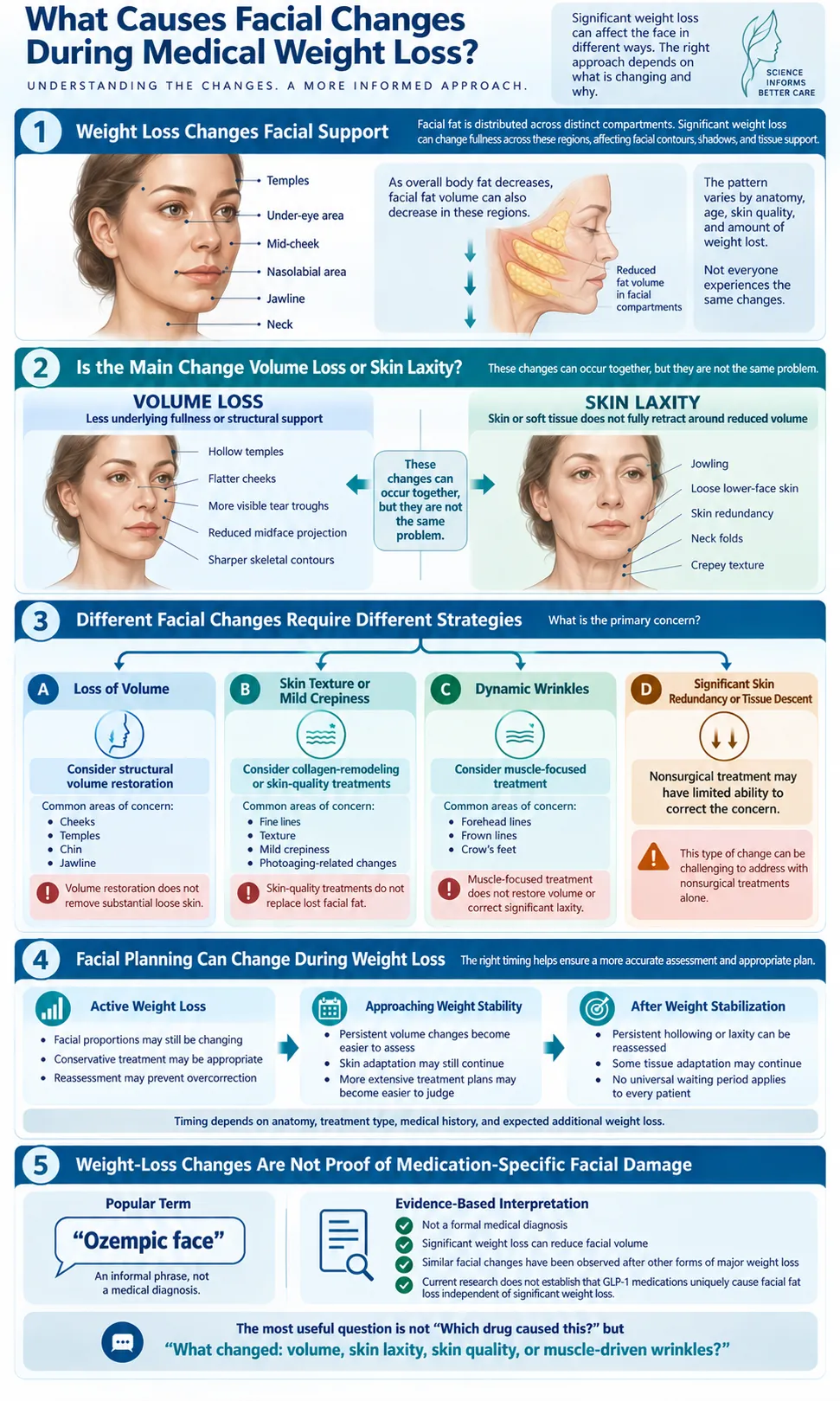
Facial changes during significant weight loss occur because facial fat, structural support, and skin drape can change differently from person to person. Baseline anatomy, age, skin elasticity, and the amount of tissue change all influence whether the result looks sharper, more hollow, or more lax.
Facial Fat Is Compartmentalized
Facial fat is not one continuous layer that shrinks evenly. Separate superficial and deep compartments contribute to cheek projection, temple fullness, the under-eye area, and other contours, so changes can appear regional.
- Cheek volume may decrease more noticeably than temple fullness.
- Under-eye shadows can become more noticeable.
- Baseline anatomy affects which areas change first.
- Deep and superficial fat can influence contours differently.
Anatomical research confirms that facial subcutaneous fat is divided into multiple independent compartments — Plastic and Reconstructive Surgery.
That helps explain why facial volume loss after weight loss can look very different between two people who lose a similar amount of body weight.
Volume Loss Changes Facial Support
When facial fullness decreases, the effect is not limited to the area where fat was lost. Reduced support can change how neighboring folds, shadows, and lower-face contours appear even when those structures were already present.
- Less cheek projection can emphasize nasolabial folds.
- Temple deflation may create a more angular appearance.
- Orbital contours may make tear troughs more visible.
- Changes to lower-face support can accentuate jowling or marionette lines.
A deeper-looking fold is not necessarily new; reduced surrounding volume may simply make it more visible.
Skin Does Not Always Retract Equally
Skin can contract after underlying volume decreases, but it does so to varying degrees from person to person. Elasticity, collagen and elastin quality, sun exposure, smoking history, age, and prior stretching all matter.
- Some people gain noticeably sharper jawline definition.
- Others develop loose or crepey skin along the lower face.
- Photodamage can make texture changes more apparent.
- Reduced volume can expose laxity that was previously less visible.
The assessment therefore separates lost support from the skin envelope’s ability to adapt.
Does Medical Weight Loss Medication Directly Cause Facial Aging?
Current evidence does not show that GLP-1 medications selectively destroy facial fat or uniquely cause facial hollowing during medical weight loss. The better-supported explanation is that substantial weight loss can alter facial volume and skin drape, regardless of how it was achieved.
Understanding “Ozempic Face”
“Ozempic face” is an informal media phrase, not a medical diagnosis. It usually describes hollowing, deflation, more visible folds, or laxity noticed after significant weight loss while taking a GLP-1 medication.
- The term does not identify a specific disease process.
- It can oversimplify several different tissue changes.
- Similar appearances can occur after non-medication weight loss.
- Not everyone using a GLP-1 develops facial hollowing.
The label can blur distinctions among lost volume, loose skin, skin quality, and movement-related wrinkles, which may coexist but require different treatment strategies.
Medication Versus Weight Loss
The key distinction is drug exposure versus the effects of losing adipose tissue. Research has not established that GLP-1 receptor agonists preferentially cause facial-fat atrophy — PMC.
- Major weight loss itself can change facial proportions.
- Similar changes have been reported after bariatric procedures.
- No incretin medication has been shown to have unique facial effects.
- Medication-specific facial damage should not be assumed.
That distinction matters for anyone concerned about facial changes during medical weight loss in Ashburn. Cosmetic concerns should not discourage medically appropriate weight management prescribed for broader health goals.
Amount and Pace Matter Differently
Greater weight reduction may make facial contour changes easier to see, while rapid loss can plausibly create a mismatch between volume reduction and skin adaptation. Research does not establish a universal threshold.
- No specific pound-loss cutoff predicts facial change.
- No percentage of body weight guarantees hollowing.
- No fixed timeline determines when laxity appears.
- Slower weight loss cannot be promised to prevent these changes.
During active loss, individual assessment is more useful than comparing your face with someone else’s timeline.
Which Facial Changes Can Happen as Weight Comes Off?
Post-weight-loss facial changes can include reduced cheek or temple fullness, more visible under-eye contours, improved jawline definition, jowling, deeper-looking folds, or looser skin. Some changes may be welcome, some may feel aging, and many people experience a mixture of both.
Cheeks, Temples, and Eyes
Facial deflation during weight loss often draws attention to the midface because cheek projection influences nearby features. As fullness decreases, under-eye shadows and temple concavity may become more noticeable.
- Cheek projection may flatten or look more angular.
- Temples can appear more concave after deflation.
- Tear troughs may look deeper as support changes.
- Orbital shadows can contribute to a tired appearance.
Under-eye darkness can also reflect pigmentation, thin skin, vascular visibility, or anatomy, so assess the cause before treatment.
Jawline and Lower Face
Weight loss can improve lower-face definition by reducing submental fullness, yet reduced support may also reveal laxity or tissue descent. A sharper jawline and more noticeable jowls can coexist.
- Reduced submental fat may improve neck and jaw definition.
- Lower-face skin may drape differently as volume declines.
- Marionette contours can become more apparent.
- Jowling may reflect laxity rather than persistent excess fat.
Changes in facial contour after weight loss should not automatically trigger more fat reduction; the main issue may now be support or skin quality.
Wrinkles, Folds, and Skin Texture
Wrinkles and folds may become more noticeable after weight loss without representing sudden biological aging. Reduced support can expose existing lines, while sun damage, repetitive movement, and skin quality contribute independently.
- Nasolabial folds may deepen visually as cheek support decreases.
- Crepey texture can become more obvious with laxity.
- Dynamic lines still come from repeated muscle activity.
- Pigment and photodamage remain separate skin-quality concerns.
A systematic review of facial changes after bariatric surgery found only four cohort studies involving 129 patients, and the evidence remained inconclusive — PubMed.
The evidence supports variability rather than a universal post-weight-loss facial pattern.
If you’re ready to better understand your options for Facial Changes During Medical Weight Loss in Ashburn, our team at RxWellness Aesthetics & Anti-Aging is here to help. Call (571) 569-6546 to schedule your consultation.
How Are Facial Changes Evaluated During Ongoing Weight Loss?
Aesthetic planning during medical weight loss begins by identifying what has changed and whether weight is still actively shifting. Providers assess volume loss, skin laxity, texture concerns, and dynamic wrinkles separately because each responds to different treatments and may require different timing during ongoing weight loss.
Separate Volume From Laxity
Facial hollowing during medical weight loss and loose skin can occur together, but they are different problems. Evaluation identifies where fullness has decreased and where skin support has diminished.
- Filler may help restore selected facial volume deficits.
- Filler does not meaningfully tighten substantial loose skin.
- Skin-focused treatments do not replace lost cheek volume.
- Significant tissue descent may exceed the limits of nonsurgical treatment.
Separating these concerns helps avoid using one treatment for a problem it was not designed to correct.
Consider Skin Quality and Wrinkles
Texture, fine lines, pigment, crepiness, and movement-related wrinkles may become more noticeable as facial fullness changes. They deserve separate assessment because they arise from skin condition or muscle activity rather than from fat loss alone.
- Neurotoxins address selected muscle-driven dynamic wrinkles.
- Microneedling supports collagen remodeling and texture goals.
- Chemical peels target selected pigment and surface concerns.
- PRF may support selected regenerative skin-quality goals.
Treating surface quality may improve one layer of facial rejuvenation after weight changes without implying that deeper volume has been restored.
Review Ongoing Weight Change
Aesthetic planning during medical weight loss depends on whether additional weight loss is expected. Facial proportions can continue to evolve, so the timing of a small correction may differ from that of a broader volume restoration.
- Continued loss can alter previously treated facial proportions.
- Conservative correction may be appropriate during active change.
- Reassessment can prevent treatment from outrunning the weight trajectory.
- No universal rule requires everyone to reach goal weight first.
The practical question is how stable the concern appears and whether treatment remains sensible if proportions continue to change.
Who May Consider Aesthetic Treatment for Post-Weight-Loss Facial Changes?
Treatment for post-weight-loss facial changes may be appropriate when a specific concern is identified, expectations are realistic, and medical screening supports the procedure. Candidacy depends on anatomy, health history, current medications, skin condition, future weight-loss plans, and the limits of the selected treatment.
Match Treatment to Concern
Facial rejuvenation after weight changes starts with the tissue problem, not a preset package. Deflation, dynamic lines, texture changes, pigment concerns, and laxity call for different approaches, and some people may need staged care.
- Dermal filler can address selected areas of deflation.
- Neurotoxins target wrinkles created by muscle movement.
- Microneedling can improve texture and fine lines.
- PRF may complement selected skin-rejuvenation goals.
- Chemical peels address selected superficial texture and pigment concerns.
Each treatment should remain within its intended role, supporting conservative planning and natural facial balance.
Medical and Aesthetic Screening
Before treating weight-loss-related facial volume changes, the clinical team reviews factors affecting safety and treatment selection, including medical history, medications, prior procedures, skin condition, filler history, and expected weight loss.
- Active infection may delay certain procedures.
- Previous filler or surgery can affect treatment planning.
- Medication history may influence candidacy or healing considerations.
- Weight trajectory helps determine how conservative correction should be.
Because these changes occur within a broader medical context, cosmetic planning should complement the patient’s ongoing health care.
Set Realistic Expectations
Nonsurgical treatment for skin laxity after weight loss can improve selected concerns, but it cannot fully correct major redundant skin. Good candidacy includes understanding what a procedure can improve and where its limits begin.
- Significant tissue descent may not respond sufficiently to minimally invasive care.
- Continued weight change can make aggressive filling less predictable.
- Natural-looking correction often favors conservative volume restoration.
- Discuss treatment risks before consent.
Dermal filler deserves particular safety context: accidental injection into a blood vessel can cause serious complications, including skin necrosis, stroke, or blindness — FDA.
Never minimize that uncommon risk when considering filler.
Do Facial Changes Improve After Your Weight Stabilizes?
Facial changes during significant weight loss may continue evolving after weight loss slows, especially as skin and soft tissue adapt to a more stable volume. However, full skin retraction and restoration of the previous facial-fat pattern cannot be predicted, so long-term planning remains individualized.
Changes During Active Weight Loss
During facial deflation during weight loss, the face can remain a moving target. Continued volume reduction may alter cheek projection, lower-face support, and skin drape, so reassessment may be needed later.
- Facial volume can continue declining with further weight loss.
- Skin drape may change as underlying support decreases.
- A treated area can look different as proportions evolve.
- Conservative planning can preserve flexibility for later reassessment.
Treatment before goal weight may still be reasonable when the plan accounts for expected change and favors appropriate flexibility.
What Stabilization May Change
Once weight stabilizes, skin laxity after weight loss may continue to adapt, but the extent of tightening cannot be predicted. Age, elasticity, prior stretching, and skin quality can influence what remains.
- Some people notice modest improvement in skin drape.
- Persistent laxity can remain after substantial weight reduction.
- Lost facial volume does not automatically return with stabilization.
- The evidence does not support a single mandatory waiting interval.
A stable weight can simplify assessment without becoming a universal finish line; timing still depends on the concern and treatment.
Long-Term Treatment Planning
Long-term facial rejuvenation after weight changes is usually a maintenance process rather than a permanent correction. Results depend on treatment type, anatomy, aging, sun exposure, future weight changes, and tissue adaptation.
- Filler longevity varies by product, area, and individual anatomy.
- Neurotoxin effects are temporary and require repeat treatment.
- Skin-quality treatments may be planned as a series.
- Future weight change can alter facial proportions again.
Never recommend weight gain for aesthetic reasons, as facial fat may not return to its previous distribution.
Related: Is a Med Spa in Ashburn Affordable?
What Sets RxWellness Apart
Our approach combines individualized assessment, safety screening, and realistic expectations throughout the aesthetic care process.
- Individualized treatment planning based on comprehensive consultations.
- Thorough medical history review before aesthetic treatment.
- Evidence-based treatments and research-supported methodologies.
- Rigorous safety protocols and pre-treatment screening.
- Regular progress monitoring with treatment-plan adjustments as needed.
- Balanced, natural-looking outcomes rather than standardized treatment plans.
- Clear communication and realistic expectation setting throughout care.
These clinical standards support a broader philosophy focused on facial balance, biology, and evidence-based care.
Our Philosophy: Art + Nature + Science
RxWellness uses three complementary perspectives to plan aesthetic treatment tailored to your features and goals.
- Art: Personalized treatment shaped around individual facial balance.
- Nature: Support the body’s own restorative and regenerative processes.
- Science: Use evidence-based methods and clinically grounded treatment planning.
That framework also supports practical treatment planning that can be staged to align with your priorities and budget.
Making Aesthetic Care Accessible
Aesthetic care does not always need to be done in a single visit. RxWellness provides financing and membership options that may help patients plan staged treatments or ongoing maintenance.
Cherry Financing
- Finance up to $35,000 for qualified applicants.
- 0% APR options may be available.
- Interest-bearing plans start at 5.99% APR.
- No hard credit check; decisions are often instant.
Total Wellness Bank
- $149 monthly membership provides treatment credit.
- Unused credits roll over during active membership.
- Members receive priority scheduling and filler discounts.
- Additional benefits apply under current membership terms.
Facial Changes During Medical Weight Loss in Ashburn and Related Treatments
Post-weight-loss facial changes can involve several tissue layers, so RxWellness Ashburn matches treatment to the specific issue—volume, dynamic wrinkles, texture, or skin quality—rather than expecting one service to correct every change.
Dermal Fillers
Dermal fillers can restore selected volume and projection when deflation is the primary concern. They do not meaningfully tighten substantial loose skin.
- Restore selected cheek, temple, chin, or jawline volume.
- Support contour and projection where appropriate.
- Allow conservative correction based on facial anatomy.
When dynamic wrinkles coexist with deflation, a different treatment may be more appropriate for the movement component.
Neurotoxin Injections
Neurotoxin injections temporarily reduce muscle activity behind dynamic lines. They do not replace lost facial fat or treat generalized laxity.
- Soften selected forehead and glabellar lines.
- Reduce crow’s-feet caused by repeated movement.
- Complement treatment when dynamic lines coexist.
Microneedling
Microneedling creates controlled microinjury to support collagen remodeling. It targets texture, fine lines, mild crepiness, and selected mild laxity—not lost volume.
- Supports smoother-looking skin texture over time.
- Targets selected fine lines and mild crepiness.
- Does not restore facial fat or major volume.
Skin-quality goals may also include regenerative approaches when clinically appropriate.
PRF Therapy
PRF therapy uses autologous platelet-rich fibrin for selected rejuvenation goals. It does not restore lost facial fat or replace filler.
- Uses material derived from your own blood.
- Supports selected skin-quality and rejuvenation goals.
- Keeps regenerative claims conservative and individualized.
Medical Weight Loss
Medical Weight Loss at RxWellness provides medically supervised weight management with individualized planning, regular monitoring, and ongoing support throughout treatment. Because facial appearance can continue to change as body composition changes, the weight-loss plan is an important part of deciding when aesthetic treatment may make sense.
- Supports medically supervised weight reduction.
- Includes ongoing monitoring and treatment adjustments.
- Helps the clinical team consider expected future weight changes.
- Provides context for deciding whether facial treatment should be conservative, staged, or reassessed later.
Medical weight loss does not prevent facial volume loss or skin laxity, but coordinated care can help keep aesthetic decisions aligned with the patient’s broader health goals and weight trajectory.
Ready to begin your transformation? Schedule your consultation online to visit RxWellness Ashburn today and experience the harmony of nature, science, and art in your care.
FAQs About Facial Changes During Medical Weight Loss in Ashburn
Key Takeaways
- Facial changes during significant weight loss can reflect volume loss, laxity, or both.
- Current evidence does not show preferential GLP-1-related facial-fat destruction.
- Cheeks, temples, eyes, jawline, folds, and skin texture may change in different ways.
- Tailor treatment to the concern rather than the “Ozempic face” label.
- Weight stabilization may clarify aesthetic planning during medical weight loss, but no universal waiting period exists.
- RxWellness Ashburn combines art, nature, and science in individualized aesthetic care.
- Ongoing weight-loss-related facial volume changes can affect timing, treatment choice, and maintenance planning.
Related: Can Tirzepatide in Ashburn Support Weight Management?

Understand Your Facial Changes With RxWellness Ashburn
Facial changes during medical weight loss in Ashburn can be a normal part of significant weight reduction, especially when facial volume decreases faster than the skin and surrounding tissues adapt. The important question is not whether these changes fit a media label, but whether the main concern is volume loss, laxity, skin quality, dynamic wrinkles, or a combination of several factors.
RxWellness Ashburn evaluates those concerns alongside your medical history, current weight trajectory, and aesthetic goals. Because we also provide medically supervised weight-loss care, treatment planning can account for whether your face is still changing and whether a conservative, staged, or later approach makes the most sense.
RxWellness Aesthetics and Anti-Aging Ashburn Online Reservations
43780 Central Station Dr, Suite 100B, Ashburn, VA 20147
We serve patients from Brambleton, Ashburn Village, One Loudoun, Lansdowne, Sterling, and surrounding communities.


