

Facial changes during medical weight loss in Aldie can occur when substantial weight reduction reduces facial fat volume and alters how the skin rests over the underlying tissues. Your age, facial anatomy, skin quality, and starting facial fullness all influence what you notice. Current evidence does not show that GLP-1 medications uniquely target facial fat. A systematic review found no evidence that GLP-1 receptor agonists preferentially cause facial fat atrophy — PMC.
For some people, facial changes during significant weight loss mean sharper contours. Others notice hollowing, deeper shadows, jowling, or crepey skin. RxWellness Aesthetics & Anti-Aging in Aldie evaluates what has actually changed before recommending aesthetic care.
Related: How Does Treatment for Jowls in Aldie Work?
Why Do Facial Changes During Medical Weight Loss in Aldie Happen?
Facial appearance can change because weight loss reduces some of the soft-tissue volume that supports the face, while the skin must adapt to a smaller underlying structure. The result depends on where you lose volume, your baseline anatomy, skin elasticity, age-related changes, and how much weight you ultimately lose.
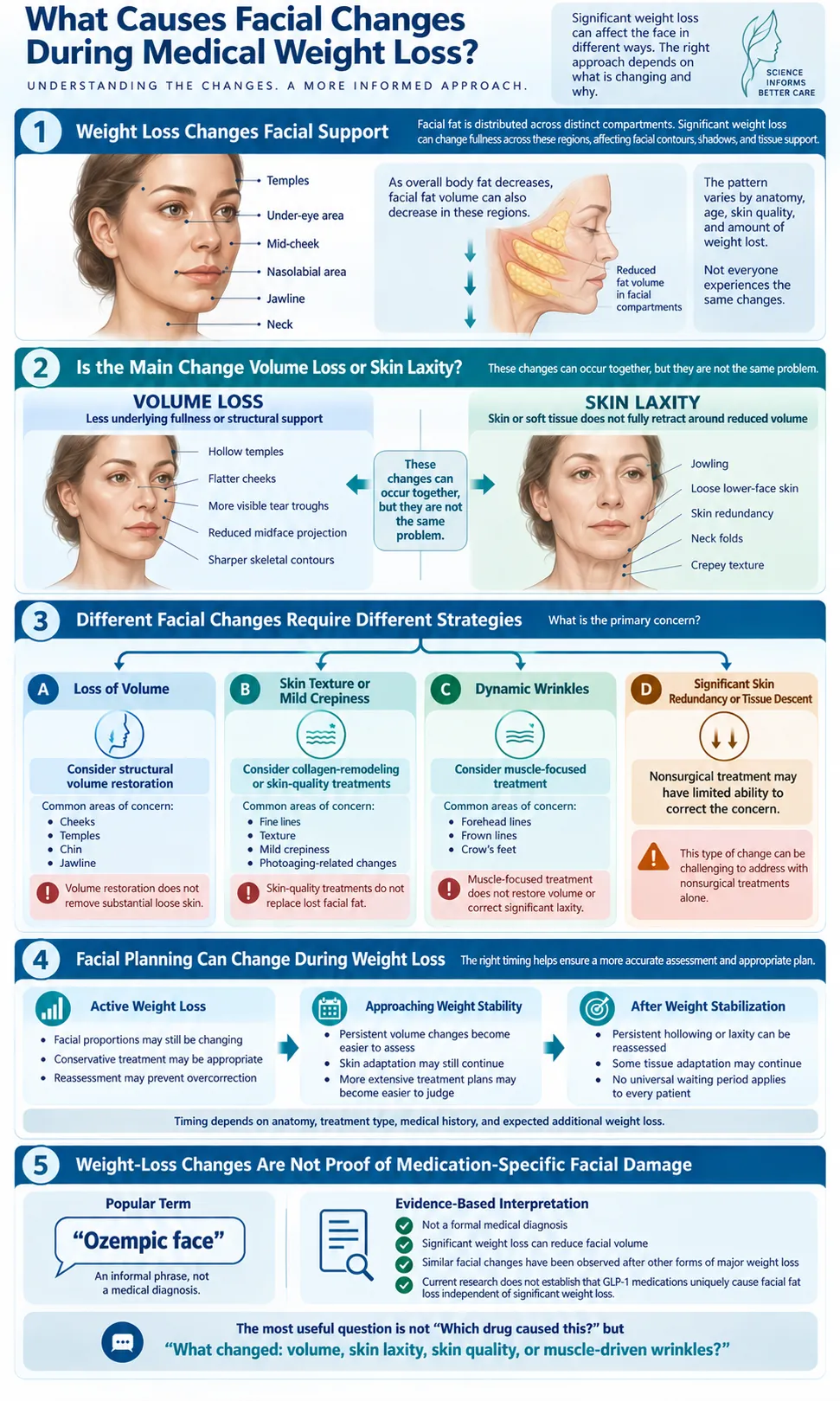
Facial Fat Is Compartmentalized
Facial fat is arranged in distinct anatomical regions rather than one continuous layer, so facial volume loss after weight loss can appear differently across the cheeks, temples, under-eyes, and jawline.
- Midface fullness may decrease, flattening the cheeks.
- Temple changes can make surrounding contours look sharper.
- Under-eye shadows may become more noticeable.
- Jawline changes can reveal pre-existing lower-face laxity.
An anatomical study describes facial subcutaneous fat as multiple independent compartments — Plastic and Reconstructive Surgery.
This regional organization helps explain why facial hollowing during weight loss isn’t identical across patients.
Weight Loss Changes Support
When facial fullness decreases, existing features may become more noticeable. Changing facial contours during weight loss can expose bony landmarks, alter shadows, and reduce soft support around folds.
- Cheeks may look flatter or less projected.
- Tear troughs can appear deeper as surrounding fullness changes.
- Nasolabial folds may look more noticeable in some patients.
- A leaner jawline may look sharper or more lax.
The same overall weight loss can therefore produce very different aesthetic concerns depending on baseline facial structure.
Aging and Elasticity Matter
Skin does not always retract fully after volume changes. Skin laxity after substantial weight loss may be more noticeable when age-related collagen changes or environmental damage already affect firmness.
- Declining collagen and elastin can reduce skin resilience.
- Sun exposure may contribute to visible texture and laxity.
- Smoking can affect skin quality and healing potential.
- Menopausal changes may influence skin thickness and elasticity.
Age alone cannot predict your outcome; baseline skin quality, genetics, structure, and prior volume also shape facial deflation after weight loss.
How Do Facial Volume Loss and Skin Laxity Differ?
Volume loss means the face has less underlying fullness or structural support, while laxity refers to skin or soft tissue that has not fully retracted around the smaller facial envelope. Both can occur together, but they are different problems and may require different treatment strategies.
Signs of Volume Loss
Volume loss changes projection, fullness, and transitions between features. Post-weight-loss facial changes linked to deflation may appear as hollow areas, sharper skeletal contours, or deeper-looking grooves.
- Temples may appear hollow or more concave.
- Cheeks can lose projection through the midface.
- Tear troughs may look deeper or more shadowed.
- Chin and jawline proportions may shift visibly.
Not every hollow area needs filler. Assessment should distinguish lost volume from baseline anatomy, tissue descent, or mixed changes.
Signs of Skin Laxity
Laxity involves skin and tissue drape more than missing volume. During facial changes during medically supervised weight loss, looseness may become more noticeable around the lower face and neck.
- Jowling may become more apparent along the jawline.
- Neck folds can remain after underlying volume decreases.
- Crepey texture may reflect skin-quality changes.
- Redundant skin can persist despite stable body weight.
Research reported notable regional volume reduction in the mid-cheek, along with central neck skin laxity, after major weight loss — Aesthetic Surgery Journal Open Forum.
This supports viewing volume and laxity as related but separate concerns.
Why the Difference Matters
A useful aesthetic plan starts by identifying the tissue responsible for the concern. Facial volume loss after weight loss, laxity, texture changes, and dynamic wrinkles each respond differently to treatment.
- Filler can support selected volume deficits but cannot remove loose skin.
- Microneedling targets skin quality rather than lost facial fat.
- Neurotoxins address muscle-driven lines, not hollow cheeks.
- Significant redundancy may exceed the capabilities of nonsurgical treatment.
When several issues coexist, treatment can be staged around the highest-priority concern rather than compensating for the wrong tissue problem.
Which Facial Changes Can Be Addressed With Nonsurgical Care?
Nonsurgical aesthetic care can address selected volume deficits, skin-quality concerns, and muscle-driven wrinkles that become more noticeable during weight loss. The right approach depends on the underlying change, and meaningful skin redundancy or tissue descent may remain outside what injectable or collagen-remodeling treatments can reasonably correct.
Restoring Selected Volume
Dermal filler may help when structural deflation is the dominant concern. For facial rejuvenation after weight changes, planning should account for anatomy, anticipated further loss, and the risk of overcorrection.
- Cheeks may receive support when midface projection is reduced.
- Temples can be evaluated for selected volume restoration.
- Chin or jawline treatment may improve structural balance.
- Selected folds may soften when surrounding support improves.
Dermal fillers also carry rare but serious risks. Accidental injection into a blood vessel can cause tissue death, stroke, or blindness — FDA.
Careful screening, anatomy-based technique, and realistic expectations matter whenever you consider filler.
Improving Skin Quality
Microneedling and platelet-based facial treatments may support texture and rejuvenation goals without replacing facial fat. These options fit when aesthetic concerns during medical weight loss include fine lines or mild crepiness.
- Microneedling creates controlled micro-injury to stimulate remodeling.
- Treatment may improve selected fine lines and texture.
- PRP can be used as an adjunct for skin-quality goals.
- Neither approach restores lost facial fat compartments.
PRP evidence remains limited. If reduced fullness drives the concern, skin-quality treatment may improve the surface without recreating underlying projection.
Treating Dynamic Wrinkles
Neurotoxin injections target wrinkles created by repeated muscle movement. They can remain relevant as facial contours change with weight loss, but they do not restore volume or tighten redundant tissue.
- Targeted muscle relaxation may soften forehead lines.
- Frown lines can be treated independently of weight change.
- Crow’s feet may respond to carefully placed neurotoxin.
- Hollowing and major laxity require different treatment planning.
Dynamic wrinkles, volume loss, and laxity can coexist, so a clear diagnosis matters before choosing treatment.
If you’re ready to better understand and address Facial Changes During Medical Weight Loss in Aldie, our team at RxWellness Aesthetics & Anti-Aging is here to help. Call (571) 569-6546 to schedule your consultation.
What Should You Expect From Aesthetic Care During Active Weight Loss?
Aesthetic care during active weight loss should begin with assessment and remain flexible as facial proportions change. Some concerns can be treated conservatively before reaching goal weight, while larger volume-restoration plans may be easier to judge once major weight changes have slowed and the face becomes more stable.
Start With Assessment
An aesthetic consultation should identify what is changing before selecting a procedure. Facial changes during significant weight loss can involve volume, laxity, texture, pigment, or dynamic wrinkles, often in combination.
- Discuss current and expected weight changes.
- Review prior fillers and aesthetic procedures.
- Skin quality and healing factors require individual assessment.
- Treatment goals should match the tissue being addressed.
At RxWellness Aldie, the assessment also considers whether the concern may continue to change, which can favor a more conservative plan.
Treat Conservatively During Loss
Ongoing weight loss can continue changing facial volume and skin drape. For facial hollowing during weight loss, a smaller or staged intervention may be more appropriate than a large early correction.
- You may treat dynamic wrinkles while weight loss continues.
- Skin-quality goals can sometimes be addressed conservatively.
- Filler plans should account for expected additional loss.
- Reassessment can prevent unnecessary early overcorrection.
No universal rule requires postponing all aesthetic care; timing depends on whether the chosen treatment remains useful as proportions change.
Keep Medical Goals Primary
Cosmetic concerns should not undermine medically appropriate weight-loss treatment. Aesthetic concerns during medical weight loss vary, while the potential health benefits of successful treatment should remain the primary focus.
- Facial change is possible, not inevitable for every patient.
- Medical needs and monitoring should guide weight-loss pace.
- Cosmetic treatment should adapt to the medical plan.
- Appearance alone should not drive medication changes.
The aesthetic plan should work around appropriate medical care, not ask medical care to work around appearance.
Who May Be a Candidate for Facial Rejuvenation During Medical Weight Loss?
Candidacy depends on the specific concern and the procedure being considered. Your facial anatomy, skin condition, medical history, healing factors, treatment goals, and expected weight trajectory all matter. A good candidate also understands what nonsurgical care can improve and where its limits begin.
Anatomy and Treatment Goals
Baseline structure influences how post-weight-loss facial changes appear and which treatment may fit. Naturally lean cheeks, deep-set eyes, existing laxity, and facial proportions can all shape planning.
- Volume deficits need different planning than texture concerns.
- Dynamic wrinkles require a muscle-focused treatment strategy.
- Existing laxity can limit what added volume accomplishes.
- Naturally lean anatomy should not automatically be “corrected.”
Treatment should address a defined concern while preserving the proportions already present in your face.
Medical and Skin Factors
Before treatment, your medical and skin history should be reviewed because procedures have different contraindications. Facial rejuvenation after weight changes still requires attention to medications, healing, infection risk, and prior procedures.
- Current medications may affect procedure planning or recovery.
- Nutritional status can influence healing and tissue quality.
- Active infection may delay certain aesthetic procedures.
- Smoking history can affect skin and healing considerations.
Prior filler can affect anatomy and future choices, so screening should be treatment-specific rather than based on a blanket weight-loss rule.
Expectations and Limitations
A good candidate has goals that match what nonsurgical treatment can realistically achieve. Skin laxity after substantial weight loss may exceed what injectables or surface-remodeling procedures can meaningfully improve.
- Continued weight loss may alter an early aesthetic result.
- Overfilling should not compensate for major tissue descent.
- Significant redundant skin may need surgical-level correction elsewhere.
- Improvement should not be confused with recreating the past.
If a concern falls outside RxWellness services, discuss that limitation plainly before treatment.
When Should You Address Facial Changes During or After Weight Loss?
No universal waiting period exists for facial aesthetic care after medical weight loss. Timing depends on the treatment, the expected additional weight change, and whether the feature being treated is stable enough for useful planning. Different concerns can reasonably be addressed at different stages.
During Active Weight Loss
Some concerns can be addressed while weight loss continues. Reassess facial changes during medically supervised weight loss, as the balance among fullness, laxity, and contour may evolve.
- Dynamic wrinkles can remain treatable during active loss.
- Skin-quality procedures may fit selected patient goals.
- Large filler corrections may become outdated as weight changes.
- Expectations should include the possibility of continued facial evolution.
Conservative choices leave room to reassess when substantial additional weight loss is still expected.
Near Weight Stabilization
Larger volume-restoration decisions may be easier once major weight change slows. Facial deflation after weight loss can continue to evolve, so reassessment once at a more stable weight may clarify persistent concerns.
- Stable trends can make facial proportions easier to evaluate.
- Persistent hollowing may become easier to distinguish from transition.
- Skin retraction may continue after major loss slows.
- No universal weight threshold applies to aesthetic treatment.
One post-bariatric planning paper describes a weight-stability convention of no more than 2.5 kilograms of change per month for three months — Aesthetic Plastic Surgery.
That is context from body-contouring literature, not a mandatory RxWellness rule for filler or facial treatment.
Changes After Weight Stabilizes
After weight stabilizes, the face may continue to adapt, but you can’t predict skin retraction and volume changes individually. Persistent post-weight-loss facial changes may persist even after body weight stabilizes.
- Some looseness may improve as tissues continue adapting.
- Persistent laxity can remain despite stable weight.
- Hollowing may remain visible after the loss phase ends.
- Weight regain cannot guarantee that previous facial fat distribution returns.
Treatment can then focus on persistent changes. Weight regain should not be recommended as an aesthetic strategy for restoring facial fullness.
Related: How Does Tirzepatide in Aldie Work for Weight Loss?
Why Choose RxWellness Aldie for Facial Changes During Medical Weight Loss?
RxWellness Aesthetics & Anti-Aging Aldie approaches facial changes during medical weight loss in Aldie by first determining whether the concern involves volume, skin quality, dynamic wrinkles, laxity, or a combination of these factors. Our aesthetic specialists can then develop a conservative plan tailored to your anatomy, medical history, weight trajectory, and goals.
What Sets RxWellness Apart
Individualized aesthetic care starts with careful screening and realistic expectations, not assuming every patient needs the same procedure.
- Evidence-based treatments and protocols
- Individualized treatment planning
- Comprehensive consultations
- Thorough medical history review
- Regular progress monitoring
- Thorough pre-treatment screening
- Realistic expectation setting
That clinical foundation supports a broader philosophy built around balance, biology, and evidence-informed aesthetic decisions.
Our Philosophy: Art + Nature + Science
RxWellness combines aesthetic judgment with regenerative principles and clinical evidence to keep treatment focused on your natural facial proportions.
- Art: Plans shaped around individual facial balance and proportion
- Nature: Supporting the body’s own regenerative processes when appropriate
- Science: Evidence-informed treatment selection and clinical monitoring
That philosophy also includes practical treatment planning around timing, maintenance, and the financial structure that works for you.
Making Aesthetic Care Accessible
Aesthetic care does not have to be compressed into one visit. RxWellness provides ways to plan treatment around your priorities, timing, and budget.
- Financing available up to $35,000
- 0% APR options available for qualified applicants
- Interest-bearing plans starting at 5.99% APR
- No hard credit check when checking eligibility
- Instant decision in most cases
- $149 monthly membership
- Monthly fee can be applied as treatment credit
- Unused credits roll over while membership remains active
- Priority booking
- Relevant benefits include 10% off dermal fillers and other applicable member pricing and benefits
With those practical options in place, the next step is understanding which treatments may fit the specific facial changes you are seeing during medical weight loss.
Facial Changes During Medical Weight Loss in Aldie and Related Treatments
RxWellness Aldie pairs medically supervised weight-loss care with aesthetic treatments selected for specific concerns. The goal is to assess volume, skin quality, wrinkles, and changing contours so each treatment has a defined role.
Medical Weight Loss
Medical weight loss combines personalized dosing, monitoring, blood work, nutrition and exercise guidance, and ongoing support.
- Personalized tirzepatide dosing and clinical monitoring
- Blood work helps guide ongoing medical decisions
- Nutrition and exercise guidance support treatment goals
Medical goals remain primary when appearance changes enter the conversation.
Dermal Fillers
Dermal fillers can restore selected structural support when volume loss is the primary concern, with conservative placement based on anatomy and expected change.
- Supports selected cheek or temple volume deficits
- Can refine chin and jawline proportions
- Does not tighten significant loose skin
Neurotoxin Injections
Neurotoxin injections reduce muscle-driven wrinkles such as forehead lines, frown lines, and crow’s feet.
- Treats movement-related facial lines
- Does not replace lost facial fullness
- Does not correct significant skin redundancy
Texture concerns require a different approach from muscle-driven wrinkles.
Microneedling
Microneedling creates controlled micro-injuries that encourage collagen remodeling for selected texture, fine lines, photoaging, and mild crepiness goals.
- Supports smoother-looking skin texture
- May improve selected fine lines
- Does not restore lost facial fat
PRP Facial
PRP facial treatment uses platelet-derived components for selected rejuvenation and skin-quality goals, with limited evidence-based expectations.
- Supports selected facial rejuvenation goals
- May complement skin-quality treatment planning
- Does not regenerate facial fat compartments
Ready to begin your transformation? Schedule your consultation online to visit RxWellness Aldie today and experience the harmony of nature, science, and art in your care.
FAQs About Facial Changes During Medical Weight Loss in Aldie
Key Takeaways
- Facial changes during significant weight loss can involve volume, laxity, texture, and wrinkles.
- Current evidence does not show GLP-1 medications selectively destroy facial fat.
- Volume loss and loose skin are different concerns that require different strategies.
- Conservative treatment may be appropriate while weight is still changing.
- RxWellness combines art, nature, and science in individualized aesthetic planning.
- Aldie patients can access medical weight loss, fillers, neurotoxins, microneedling, and PRP facial care close to home.
Related: Can a Med Spa in Aldie Deliver Visible Results Quickly?

Understand Facial Rejuvenation During Weight Loss at RxWellness Aldie
Facial changes during medical weight loss in Aldie do not have a single cause or a single treatment. Understanding whether you are experiencing lost volume, skin laxity, texture changes, dynamic wrinkles, or a combination helps make treatment planning more precise and realistic. RxWellness Aesthetics & Anti-Aging supports patients with medically guided care and individualized aesthetic options, while keeping healthy weight-loss goals as the primary focus.
RxWellness Aesthetics and Anti-Aging Aldie Online Reservations
24600 Millstream Dr, Suite 360, Aldie, VA 20105
We serve patients from Aldie, South Riding, Stone Ridge, Lenah, Arcola, and Middleburg.


